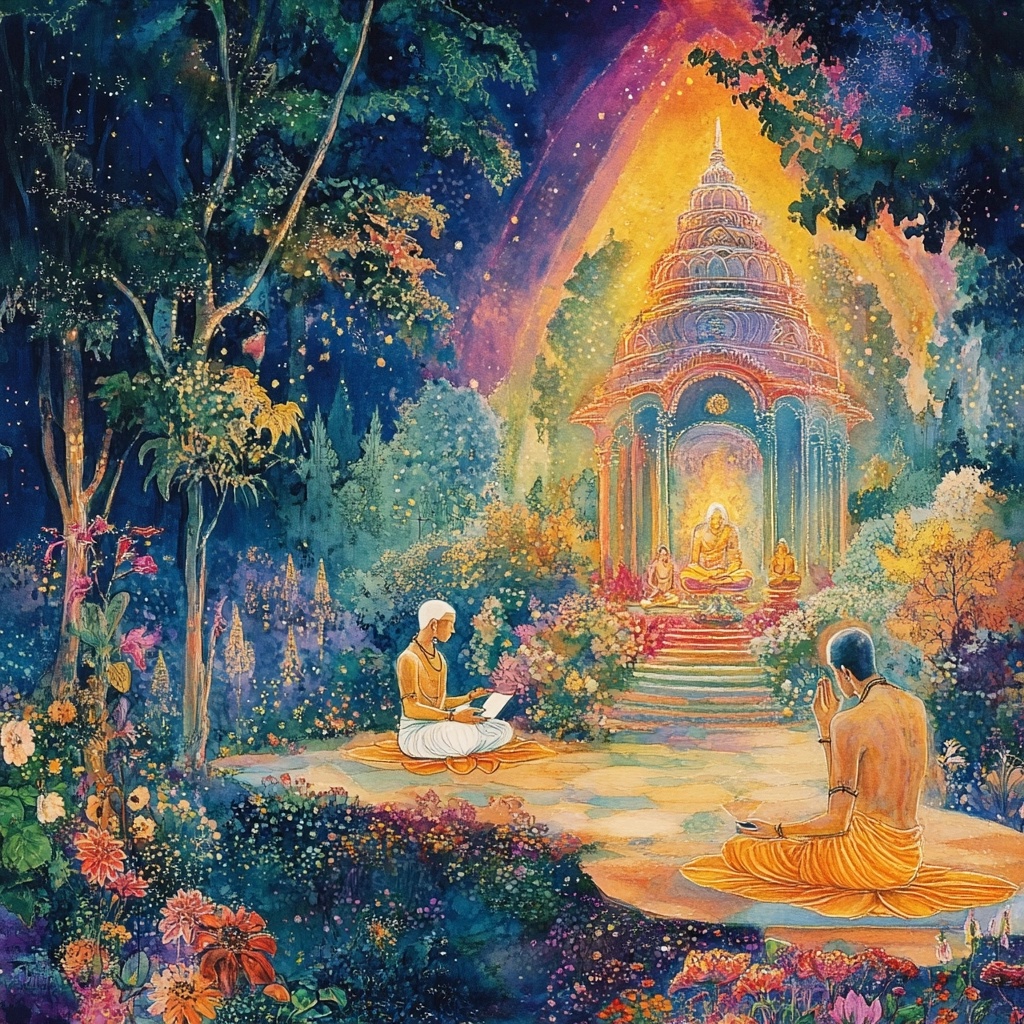
In the vast ocean of spiritual wisdom that has flowed from India’s ancient traditions, the vocabulary of yoga represents not merely a collection of terms, but a constellation of profound insights into the nature of consciousness and reality. This Yogic Encyclopedia serves as both compass and map for those navigating the transformative journey toward self-realization.
The language of yoga is not merely descriptive but vibrational—each term resonates with the energy it describes. From Adhibhuta (the consciousness immanent in physical creation) to Yogi (one who practices scientific techniques of God-contact), these concepts form a coherent framework for understanding the multi-dimensional nature of human experience and divine consciousness.
This encyclopedia, inspired by the teachings of Paramhansa Yogananda—who introduced these timeless practices to the Western world in the 20th century—offers seekers clear definitions of the subtle realities that exist beyond ordinary perception. Through Yogananda’s lineage and the Ananda movement founded by his direct disciple Swami Kriyananda, these ancient teachings have been preserved and presented in ways accessible to the modern mind without diluting their essential power.
Whether you approach these teachings as a dedicated practitioner, a curious explorer, or a serious scholar, this compendium provides illumination on the path—clarifying the stages of spiritual awakening, the nature of consciousness, the subtle anatomy of the soul, and the practices that lead to direct experience of divine reality.
Unlike conventional dictionaries that merely classify and categorize external phenomena, this Yogic Encyclopedia maps the interior landscape of consciousness itself. It describes not only what is, but what can be—the latent divine potential within each human being. The terms collected here are tools for transformation, keys that unlock doors to higher awareness when properly understood and applied.
May this encyclopedia serve not only as a reference of definitions but as a source of inspiration, reminding us that the ultimate purpose of knowledge is experience—the direct, personal realization of the truths these words point toward. In the tradition of the great yogis, may these teachings lead you to that place beyond words, where the soul reunites with its infinite source in ever-new, ever-conscious bliss.
“The goal of yoga science is to calm the mind, that without distortion it may hear the infallible counsel of the Inner Voice.” — Paramhansa Yogananda
A
Adhibhuta – The consciousness immanent in physical creatures and the physical cosmos.
Adhidaiva – The consciousness manifest in astral bodies and in the astral cosmos.
Adhiyagya – The Supreme Creative and Cognizing Spirit; God; both the causal world and God Himself, without the illusion of the physical or astral worlds.
Adhyatma – Oversoul; God manifested as the soul of all beings.
Affirmation – A statement of truth which one aspires to absorb into his life.
Agya Chakra – The sixth chakra or highest spinal center. The center of consciousness of enlightened beings.
Ahankara – Ego, or ego-consciousness. The root cause of self-awareness.
Ahimsa – Non-harmfulness (harmlessness). To not wish harm to any living creature—not even to any lifeless object.
Anahata Chakra – The fourth chakra or heart center. Expresses as love, for either the divine or the material world.
Ananda – Bliss or Divine Joy; also the name of a worldwide movement based on the teachings of Paramhansa Yogananda and founded by Swami Kriyananda.
Apana – The outgoing breath; descending energy in the astral spine.
Aparaprakriti – The outer world that we can experience through the senses.
Asana – To be seated in a firm, pleasant, and relaxed position. Paramhansa Yogananda said that asana means keeping the spine straight and the body relaxed.
Ashtanga Yoga – A system developed by the ancient yogic sage Patanjali outlined in his yoga sutras. It consists of eight progressive stages on the path to Self-realization.
Astral Body – The type of body one possesses in the astral world, where most beings go after death. It is made of prana, or life force.
Astral World – A world of energy rather than physical matter made of vibrations of light and color, where most physical beings go after death and before reincarnating.
Atman – Spirit or soul. The Supreme Self that is immortal and ever-changeless.
AUM (Om) – The vibration by which the Supreme Spirit brings all things into manifestation. It is the Holy Ghost of the Christian Trinity.
Avatar – “Divine descent,” typically used to describe an incarnation of God such as Jesus Christ, Buddha, or Krishna.
B
Bandha – Literally “lock” or “closed.” A particular type of yogic technique for raising the kundalini energy in the spine, which helps one to attain Self-realization.
Bhakti Yoga – Union with God through devotion. A bhakti yogi thinks of God in personal terms.
Bhav – Spiritual feeling or attitude; devotion; the religious attitude of immersing oneself in the thought of God.
Bishuddha Chakra – The fifth chakra or throat center. Controls the voice and speech, and allows one to break through the veils of delusion.
Brahmacharya – The student stage of life. The first of four ashrams or stages of life in Hindu philosophy.
Brahman – The Indestructible and Supreme Spirit. It is in every atom of creation, but remains there as the Viewer, meaning it is not affected by the physical matter it is in.
Brahmanadi – The causal (deepest) spine. Raising one’s energy through the brahmanadi is the last test a yogi must go through to attain full union with the Divine.
Brahmin – A person who knows God; a priest. One of the four Hindu castes.
Brahmisthiti – Absolute oneness with the Infinite.
Buddhi – Intellect; discernment. One of the four aspects of consciousness.
C
Caste System – System of four true castes or “races” of man. Based not on birth but on man’s natural capacities and goals of life.
Causal Body – A body made of thought or ideas, rather than physical matter. A causal body is very similar to an individual soul.
Causal World – The world of ideas or thoughts. It is the most subtle of the three worlds, or the closest one to God.
Chakra – Literally means “wheel”. Refers to centers of energy in the astral spine.
Chela – Disciple; from Sanskrit verb root, “to serve.” Close student.
Chitta – Feeling, centered in the heart. It is subjectivity, one’s emotional reaction, affected by what it sees and its own nature.
D
Darshan – The blessing which flows from the mere sight of a saint.
Day of Brahma – A period of one kalpa or a thousand mahayugas during which creation is manifested.
Dharana – One-pointed concentration, fixing one’s full attention on one place, object, or idea at a time. The sixth limb of Ashtanga Yoga.
Dhyana – Absorption; union. The seventh limb of Ashtanga Yoga, defined as “concentration on higher aspects of reality.”
E
Ego – A soul attached to a body. The ego divides the world into “mine” and “not mine.”
G
Grihastha – The householder stage of life. The second of four ashrams or stages of life in Hindu philosophy.
Gyana (Jnana) Yoga – Union with the Divine through wisdom or knowledge of the Divine. Also referred to as the path of discrimination.
H
Hatha Yoga – A school of Yoga that stresses mastery of the body as a way of attaining spiritual perfection in which the mind is withdrawn from external objects.
I
Ida – The left energetic nerve channel along the astral spine. Energy moves upward through the ida nadi with the breath.
J
Jivan Mukta – One who is inwardly free while living in this world.
K
Kali Yuga – A 2,400-year age of darkness during which consciousness is limited to gross matter.
Karma – The law of cause and effect. “Whatsoever a man soweth, that shall he also reap.”
Kosha – Sheath. That which encloses the pure consciousness of Spirit in its material manifestations.
Kshatriya – A person who surrenders his ego consciousness to God; a warrior or nobleman. One of the four Hindu castes.
Kundalini – Energy at the base of the spine. Can be awakened for true spiritual unfoldment in aspirants.
M
Magnetism – Spiritually, the force of God to attract and Satan to repel.
Manas – The perceiving mind. One of the four aspects of consciousness. Also known as mon.
Manipura Chakra – The third chakra or lumbar center. Expresses as anger or fiery self-control.
Mantra – Potent vibratory chant. The literal translation is “instrument of thought,” signifying the ideal, inaudible sounds which represent one aspect of creation.
Maun – Complete silence; the spiritual practice of perpetual silence.
Maya – Cosmic illusion; literally, ‘the measurer.” Maya is the power in creation by which limitations and divisions seem to exist in the Oneness that is true reality.
Mon – The perceiving mind, which shows us an image as it appears to us through the senses. Centered at the top of the head.
Muladhara Chakra – The first chakra or coccyx center. Supports an attitude of either perseverance or stubbornness.
N
Night of Brahma – A period of one kalpa or a thousand mahayugas during which creation is unmanifested.
Nishkam Karma – Action without desire for the fruits of action that allows one to gradually and ultimately free oneself from the bondage of karma.
Niyama – The second stage of the spiritual path as outlined by Patanjali in his yoga sutras. It lists five things you should do to make spiritual progress.
P
Param Mukta – A supremely free soul that has been liberated from the actions committed by his soul in delusion during all incarnations.
Patanjali – An ancient exponent of raja yoga and the author of the Yoga Sutras, a series of verses about the eight steps needed to attain Self-realization.
Pilgrim Vow – Taken by one who wishes to make a greater commitment to God.
Pingala – The right energetic nerve channel along the astral spine. Energy moves downward through the pingala nadi with the breath.
Prana – Energy, life, or breath. In other traditions, it is called chi or qui.
Pranayama – A technique of breath control to withdraw ones senses from the outside world. This helps raise Kundalini energy up the spine to the spiritual eye.
Pratyahara – The withdrawing of the mind and senses from the objects of the senses. The fifth limb of Ashtanga Yoga.
Purusha – The positive principle of the universe.
R
Rajas (or Rajoguna) – The activating element of nature. That which represents movement between the two opposing sides of duality.
S
Sadhu – A holy man; one who is deeply devoted to the spiritual search.
Sahasrara Chakra – The seventh chakra or crown center. The center at which one attains liberation.
Samadhi – Perfect union of the individualized soul with infinite spirit. A state of oneness; complete absorption.
Samsara – The outward play of maya or delusion. The world of delusion in which we all live.
Sangha – Association, especially of spiritual practitioners.
Sannyas – The stage of complete renunciation. One of the four ashrams or stages of life in Hindu philosophy.
Satsang – Wholesome and uplifting company. Good company, especially on the spiritual path.
Sattwa (or Sattwa Guna) – The elevating quality of nature. That which lifts the soul toward divinity.
Sevaka Order – A monastic order in relation to Ananda communities. Membership is comprised of single people as well as householders.
Shakti – The feminine aspect of nature known as Cosmic Vibration.
Siddha – A perfected being who has worked out all past karma and freed himself from entanglement in the world of maya.
Smriti – In its root form means “memory” or “remembrance.” In spiritual terms, it is the memory of our soul nature — thus it also means “divine memory.”
Soul – The Spirit of God in each individual, which is ever-existing, ever-conscious, ever-new Bliss. The soul has the same qualities as God.
Sudra – A person at the lowest stage of consciousness; a peasant. One of the four Hindu castes.
Superconscious Mind – Heightened awareness; true wisdom.
Sushumna – The deep astral spine, through which Kundalini energy rises as a person advances spiritually.
Swadisthana Chakra – The second chakra or sacral center. Controls sexual energy and creativity.
T
Tamas – The darkening quality of nature. That which obscures the underlying unity of life.
Turiya – The state beyond deep, dreamless sleep, in which the superconscious becomes overtly active.
V
Vaishya – A person characterized by cleverness, creativity, and selfish motivations; a merchant. One of the four Hindu castes.
Vanaprastha – The stage of partial retirement from worldly life. The third of four ashrams or stages of life in Hindu philosophy.
Vedanta – One of the three main systems of Indian thought, which describes the nature of Brahman or divine consciousness.
Vishnu – The preserving aspect of the cosmic vibration AUM. Also the personification of this aspect.
Vritti(s) – Vortex, eddy, whirlpool. Cyclical movements of energy in the spine.
Y
Yagya (Yajña) – A sacrificial rite or performance of duty. It should be offered with devotion, without any desire for personal gain, and with firm belief in its rightness.
Yama – The first stage of the spiritual path as outlined by Patanjali in his yoga sutras. Yama lists the “do nots” of the spiritual path, such as “do not lie” and “do not covet”.
Yoga – Literally means “union”. Most commonly taken to mean the union of the little self, the individual, with the divine consciousness.
Yogi – Anyone who practices a scientific technique of God-contact is a yogi.
Conclusion
As we reach the end of this Yogic Encyclopedia, we are reminded that the spiritual journey is not truly about accumulating definitions and concepts, but about transcending them. The terms contained within these pages are signposts pointing toward direct experience—fingers pointing to the moon of enlightenment, not the moon itself.
Each definition represents a doorway to deeper understanding, an invitation to personal exploration. Through meditation, devotion, and selfless service, these ancient concepts come alive within us, transforming from intellectual knowledge into lived wisdom.
The great yogis teach us that true understanding comes not from reading words on a page, but from the silent communion with the Divine that these practices facilitate. As you incorporate these teachings into your life, may they serve as catalysts for your own awakening.
The journey of yoga is ultimately one of remembrance—reclaiming our awareness of our eternal nature beyond all limitations. In that spirit, we conclude this encyclopedia not with an ending, but with a beginning—an encouragement to take these timeless teachings into the laboratory of your own consciousness and discover their truth firsthand.
Om Shanti Shanti Shanti.
This glossary sourced from Ananda Yoga, inspired by Paramhansa Yogananda’s introduction of Yoga to the Western world in the 20th century. Learn a joyful, powerful way to practice meditation online, or by going to a retreat through Ananda.
 Light Being
Leave a comment